
Bergere Grillon #representationmatters
December 13, 2016 § Leave a comment
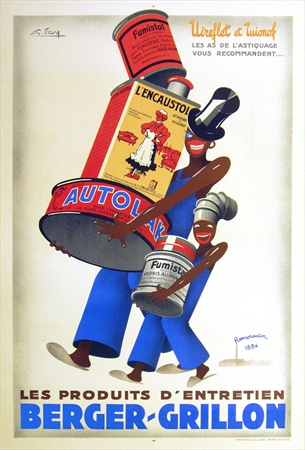
Bergere Grillon
By Georges Favre
Printed circa 1930 by Gaillard
Original Stone Lithograph
Very Fine Condition
Translation:“Aces of polish recommend the maintenance products of Berger Griffon”
Two Jazz-Age African figures carry what looks like very heavy cargo, stacks of stove black* in tins, and they smile as they labor. Both wear blue coveralls and slippers. The child in front wears an actual stove pipe as a hat which is a reference to the product. The middle figure, perhaps the mother, wears a shiny stove-pipe hat** and large hoop earrings. Fingertips are visible grasping the stack of heavy tins in this clever design yet the figures bearing the weight of toxic cleaning products smile.
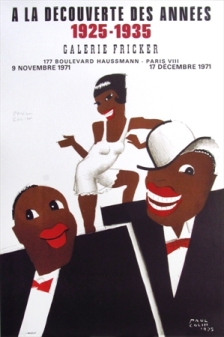
This poster was created in the late twenties, a prosperous period of Jazz and Art-Deco. American performer Josephine Baker (1906-1975) was an iconic ‘it girl’ in this period. She was often depicted with the same big red lips and big hoop earrings of the figures in the Bergere Grillon poster. Baker performed as an ‘exotic’ singer and dancer in the US, on cruise ships, and in Europe and is often depicted topless and in a banana skirt. Baker expatriated to France in 1937. Baker was a courageous woman who was objectified as a sexy, exotic performer partially because of her race. She chose to live in France because she was accepted there, more so than in the US. Baker lived with famous posterist Paul Colin, and he portrayed her in many posters including “Black Birds” and “Tabarin”.


Our show #representationmatters makes the point that nothing hides from ephemera. Cultural attitudes, norms and stereotypes are recorded in graphic form in advertising posters, and we have a collection of original material to explore here in our showroom.
*Stove black was a common household product when houses were heated by fire places and wood stoves. These polishes kept metal looking clean and new.
**Stove pipe hats were extra long top hats.
This post was written by Elizabeth Norris, VEPCA collector
#representationmatters is the current show in the VEPCA showroom
The show runs from October 1, 2016-March 15, 2017
Vintage European Posters, Established 1997
Member, IVPDA
Our Showroom: 2201 Fourth Street, Corner of Allston Way Berkeley
Winter Hours:
Tuesday – Thursday 11-5
Open Every Weekend until Christmas
Saturdays 11-6, Sundays 11-5
Also available by appointment
Contact us 510.843.2201 or email vintageposters@vepca.com
Visit our collection on the web at vepca.com
Brilliant Mecano #representationmatters
November 26, 2016 § Leave a comment
Anonymous
47.5″ x 30.5″
Printed circa 1895 in France by Imp. Emile. Pecaud. Cie
Original Stone Lithograph
Fine Condition with light folds, professionally restored
Tax Stamp in bottom right quadrant
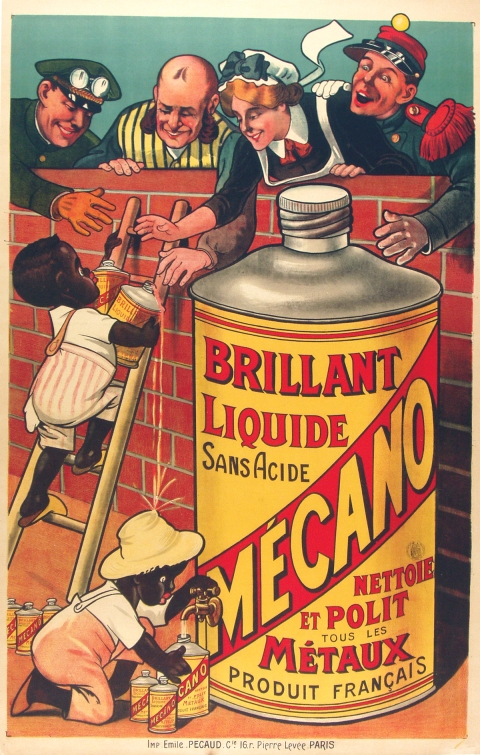
A jolly line of Caucasian servants smile as jugs of metal polish are delivered to them by African servants. Translation of the label: Brillant Mecano- a liquid polish is ‘without acid’ that can polish all metals and is made in France. The Chauffeur is eager to have his share to polish his master’s carriage or automobile, the Butler wants a jug to make the door knocker of the estate shine, the House Maid wants the polish for silver, and the Footman has plans to buff the horse’s gear to a high shine.
Our show #representationmatters makes the point that nothing hides from ephemera. Cultural attitudes, norms and stereotypes are recorded in graphic form in advertising posters, and we have a collection of material to explore over the length of our show.
Brillant Mecano is the oldest poster on display in our current show. This poster was created in the 1890’s, The Belle Epoque Era, which was the hey-day of the French advertising poster. The image of the big- lipped African children serving servants is shocking today because of its bald representation of class and race.
- There is a wall between the African child servants and the white servants
- The African child servants do not smile, their expressions show trepidation
- The African child servants are working and their work looks hazardous as evidenced by the ladder and the chemicals they are spilling
- The white household staff are smiling and touching each other
- The white household staff are receiving an aid to their work
Object Label 1
This post was written by Elizabeth Norris, VEPCA collector
#representationmatters is the current show in the VEPCA showroom
The show runs from October 1, 2016-March 15, 2017
Vintage European Posters, Established 1997
Member, IVPDA
Our Shop: 2201 Fourth Street, Berkeley Corner of Allston Way
Winter Hours:
Tuesday – Thursday 11-5
Closed on Thanksgiving
Open Every Weekend until Christmas
Saturdays 11-6, Sundays 11-5
Also available by appointment
Contact us 510 843 2201 or email vintageposters@vepca.com
Visit our collection on the web at vepca.com
Our French Antiques Pop-Up’Cadeaux’ is Open
November 18, 2016 § Leave a comment
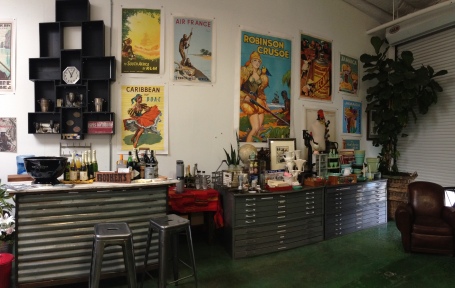
Our bar, new shelving with French Signs, American Trophies and French Champagne Buckets, plus part of our current show “Representation Matters”
We are Home for the Holidays!
Excited to announce that the VEPCA Showroom will be open every weekend until Christmas. There is plenty of parking on our side of 4th Street on the weekends, so come in for a cup a good cheer, shop the show and then walk two blocks to enjoy the Holiday Lights on Fourth Street’s Retail Corridor.
It’s a good time to explore our collection of over 2,500 original posters. We recently added to the shop hard to find books about posters, including books about Mucha, The Moulin Rouge, Pierrot Posters, Russian Avant Garde Film Posters and the exquisite, limited edition Razzia signed and numbered box set which includes the book, handsomely boxed and six prints signed by the artist.
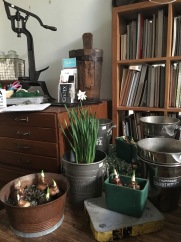
Paper Whites in Vintage Pots, an original corker + Vintage Champagne Buckets
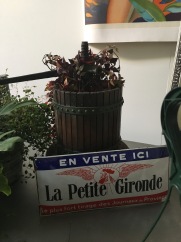
Small Wine Press + Original Enamel Newspaper sign
We are pleased to announce ‘Cadeux’, our French Antiques shop, which includes a limited supply of Vintage Champagne Buckets (including Champagne Masse, Piper, Moet and others from the Art Deco Period.
Also featuring a cool collection of vintage pottery, as well as unusual house plants, potted bulbs, vintage trophies and more. Our new bar is has been a fun addition to the shop, and we encourage you to enjoy our collection while you sip + shop.
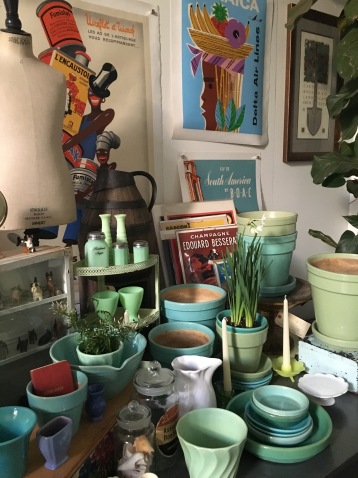
Vintage pottery and Jadite for sale
Our little block now includes Holton Frames and Gallery (at 5th and Addison) Rims and Goggles at 4th and Addison (a chic, new eye-wear shop) and of course, the anchor tenant June Taylor Artisanal Jams, our beloved next door neighbor.
We would love to see you.
Elizabeth, Sarah, Logan, and Payden
This post was written by Logan Prather, LA Liaison for VEPCA
And Elizabeth Norris, VEPCA Collector
Vintage European Posters, Established 1997
Member, IVPDA
Our Shop: 2201 Fourth Street, Berkeley Corner of Allston Way
Winter Hours:
Tuesday – Thursday 11-5
Closed on Thanksgiving
Open Every Weekend until Christmas
Saturdays 11-6, Sundays 11-5
Also available by appointment
Contact us 510 843 2201 or email vintageposters@vepca.com
Visit our collection on the web at vepca.com
History of Carthusia- Profumi di Capri
November 10, 2016 § Leave a comment

This magical poster has been a favorite our staff and clients for many years. Vintage European Posters collector Elizabeth Norris was lucky enough to find a roll of these orignal advertising posters in the South of France, and has had them lovingly cleaned and mounted to archival standard on to acid free paper and linen backing. There is a romance to the Isal of Capri, and as a result, people fall in love with the place. The poster is explanatory of the perfume and includes illustrations of flowers and fruiting moss suggesting that the scent has floral and woodsy notes.
While browsing in a boutique in Toluca Lake I saw a sign with the Carthusia symbol. I was surprised and asked the owner of the store. It turns out that the perfume is still in production today. She was generous enough to give me a few samples which do evoke the mysteries of the island. I wanted to know more, my search led me to a great tale about how this perfume came to be.

The myth recounts that in 1380, the Prior of the Carthusian Monastery was caught unawares by the arrival of Queen Joanna of Naples. He picked her a bouquet of the most beautiful flowers from the island. These remained in unchanged water for three days, when he went to throw them away, the prior noticed that it had acquired a mysterious fragrance unknown to him. He inquired of the friar versed in alchemy, who traced the origin of the scent to the “Garofilium Silvestre Caprese”. That water became the first perfume of Capri.
History relates that in 1948 the Prior of the Monastery found the old perfume formulas and upon obtaining permission from the Pope, revealed them to a chemist from Piemonte, who created the smallest perfume laboratory in the world, calling it Carthusia after the island’s Monastic order.
The symbol of the Carthusia portrays a flower siren that brings to mind the surreal and mythological landscapes of Capri’s heritage. She appears to be in the midst of an evolution, blooming with myriad colorful flowers, from which Carthusia perfumes flow.
The poster was designed in 1948 by the painter and illustrator Mario Laboccetta. Laboccetta was born in Naples in 1899, but his career blossomed in Paris in the 1920’s and 1930’s. He gained some fame with his detailed, colorful and sometimes erotic magazine and book illustrations. He published work for Charles Baudelaire’s book of poetry Les Fleurs du Mal, and the book Les Contes d’Hoffmann (Tales of Hoffmann). Laboccetta returned to his native Italy after World War II where he continued work, eventually settling in Capri, where he died in 1988.
To see more of Labocetta’s illustrations or visit the perfume’s website, check out the links below:
- http://www.johncoulthart.com/feuilleton/2011/03/08/the-art-of-mario-laboccetta/
- http://fineartamerica.com/featured/lamour-fouette-mario-laboccetta.html
- https://www.fulltable.com/vts/aoi/l/laboccetta/a.htm
- http://www.carthusia.it/
This post was written by Logan Prather, LA Liaison for VEPCA
Edited by Elizabeth Norris, VEPCA Collector
Vintage European Posters was Established 1997
Member IVPDA
Our Shop: 2201 Fourth Street, Berkeley Corner of Allston Way
Winter Hours Tuesday- Thursday 11-5
Closed on Thanksgiving
Open Every Weekend until Christmas
Also available by appointment
Please call 510 843 2201 or email vintage posters@vepca.com to confirm hours.
Visit our collection on the web at vepca.com
#representationmatters
October 7, 2016 § Leave a comment
For Immediate Release
#representationmatters: People of Color in Original Vintage Posters
Ephemera are powerful: Posters, postcards, handbills, placards, flyers are compelling from an artistic and typographic perspective, however they are also important from a socio-cultural standpoint. Ephemera are original source material, which represent the attitudes of the time in which it was made.
These bits of media were meant to be discarded, luckily, much was collected; some intentionally, some by happenstance. Elizabeth Norris, owner of Vintage European Posters in Berkeley California has been collecting ephemera since she was a child. It began with matchbooks, LPs, flyers and eventually led to a career as a poster dealer. Norris shows her collection of 2,500 original posters in a storefront in the industrial end of Berkeley’s Fourth Street neighborhood, at shows, and on her exhaustively catalogued website vepca.com
#representationmatters is on view in the VEPCA showroom from October 1st, 2016 to March 15th, 2017.
The show includes posters of Africa from Air France and other airlines, posters of Indochina, rum posters referencing plantations and posters advertising cleaning supplies (1895-1930) that depict exaggerated stereotypes.The material on display will change during the exhibit’s run.
“Nothing hides from the poster,” says Norris. “Cultural attitudes about gender, race and class are right out in the open in posters Our current show, #representationmatters, features images of non-white people and allows us to consider the impact of colonialism and racism in the 20th century.”
#RepresentationMatters dovetails with the Oakland Museum of California’s show All Power to the People: Black Panthers at 50. http://museumca.org/exhibit/all-power-people-black-panthers-50
Contact: Elizabeth Norris
High resolution photos available
#representationmatters
October 1, 2016 – March 15, 2017
Vintage European Posters Showroom
2201 Fourth Street (corner of Allston Way)
Berkeley, CA
Check our blog below for open hours

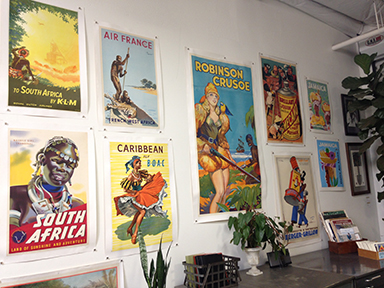

 Vintage European Posters